زغال سنگ چیست و چگونه به وجود می آید؟
What Is Coal and How Does It Form؟
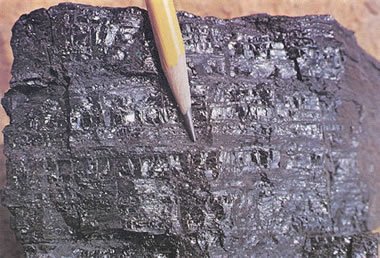
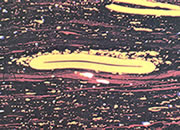
Bituminous Coal: Bituminous coal is typically a banded
sedimentary rock. In this photo you can see bright and dull bands of
coal material oriented horizontally across the specimen. The bright
bands are well preserved woody material, such as branches or stems.
The dull bands can contain: mineral material washed into the swamp by
streams, charcoal produced by fires in the swamp, or degraded plant
materials. This specimen is approximately three inches across (7.5
centimeters). Photo by the West Virginia Geological and Economic Survey.
Coal
What Is Coal and How Does It Form?
What is Coal?
Coal is an organic
sedimentary rock
that forms from the accumulation and preservation of plant materials,
usually in a swamp environment. Coal is a combustible rock and along
with oil and natural gas it is one of the three most important fossil fuels. Coal has a wide range of uses; the most important use is for the generation of electricity.
How Does Coal Form?
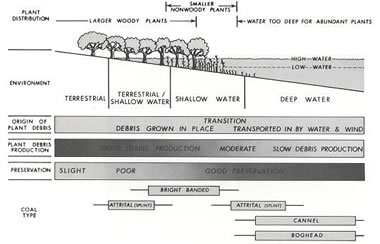
Coal-Forming Environments: A generalized diagram of a
swamp, showing how water depth, preservation conditions, plant types and
plant productivity can vary in different parts of the swamp. These
variations will yield different types of coal. Illustration by the West
Virginia Geological and Economic Survey.
Coal forms from the accumulation of plant debris, usually in a swamp
environment. When plant debris dies and falls into the swamp the
standing water of the swamp protects it from decay. Swamp waters are
usually deficient in oxygen, which would react with the plant debris and
cause it to decay. This lack of oxygen allows the plant debris to
persist. In addition, insects and other organisms that might consume
the plant debris on land do not survive well under water in an oxygen
deficient environment.
To form the thick layer of plant debris required to produce a coal seam
the rate of plant debris accumulation must be greater than the rate of
decay. Once a thick layer of plant debris is formed it must be buried
by sediments such as mud or sand. These are typically washed into the
swamp by a flooding river. The weight of these materials compacts the
plant debris and aids in its transformation into coal. About ten feet
of plant debris will compact into just one foot of coal.
Plant debris accumulates very slowly. So, accumulating ten feet of plant
debris will take a long time. The fifty feet of plant debris needed
to make a five-foot thick coal seam would require thousands of years to
accumulate. During that long time the water level of the swamp must
remain stable. If the water becomes too deep the plants of the swamp
will drown and if the water cover is not maintained the plant debris
will decay. To form a coal seam the ideal conditions of perfect water
depth must be maintained for a very long time.
If you are an astute reader you are probably wondering: "How can fifty
feet of plant debris accumulate in water that is only a few feet deep?"
The answer to that question is the primary reason that the formation of
a coal seam is a highly unusual occurrence. It can only occur under
one of two conditions: 1) a rising water level that perfectly keeps
pace with the rate of plant debris accumulation; or, 2) a subsiding
landscape that perfectly keeps pace with the rate of plant debris
accumulation. Most coal seams are thought to have formed under
condition #2 in a delta environment. On a delta large amounts of river
sediments are being deposited on a small area of Earth's crust and the
weight of those sediments causes the subsidence.
For a coal seam to form perfect conditions of plant debris accumulation
and perfect conditions of subsidence must occur on a landscape that
maintains this perfect balance for a very long time. It is very easy
to understand why the conditions for forming coal has occurred only a
small number of times throughout Earth's history. The formation of a
coal requires the coincidence of highly improbable events.
What is Coal "Rank"?
Plant debris is a fragile material compared to the mineral materials
that make up other rocks. As plant debris is exposed to the heat and
pressure of burial it changes in composition and properties. The "rank"
of a coal is a measure of how much change has occurred. Sometimes the
term "organic metamorphism" is used for this change.
Based upon composition and properties coals are assigned to a rank
progression that corresponds to their level of organic metamorphism.
The basic rank progression is summarized in the table below:
Rank
(From Lowest
to Highest) |
Properties |
Peat |
A mass of recently accumulated to partially
carbonized plant debris. Peat is an organic sediment. Burial, compaction
and coalification will transform it into coal, a rock. It has a carbon
content of less than 60% on a dry ash-free basis. |
Lignite |
Lignite is the lowest rank of coal. It is a
peat that has been transformed into a rock and that rock is a
brown-black coal. Lignite sometimes contains recognizable plant
structures. By definition it has a heating value of less than 8300
British Thermal Units per pound on a mineral matter free basis. It has a
carbon content of between 60 and 70% on a dry ash-free basis. In
Europe, Australia and the UK some low-level lignites are called "brown
coal". |
Sub Bituminous |
Sub bituminous coal is a lignite that has been
subjected to an increased level of organic metamorphism. This
metamorphism has driven off some of the oxygen and hydrogen in the coal.
That loss produces coal with a higher carbon content (71 to 77% on a
dry ash-free basis). Sub bituminous coal has a heating value between
8300 and 13000 British Thermal Units per pound on a mineral matter free
basis. On the basis of heating value it is subdivided into sub
bituminous A, sub bituminous B and sub bituminous C ranks. |
Bituminous |
Bituminous is the most abundant rank of coal.
It accounts for about 50% of the coal produced in the United States.
Bituminous coal is formed when a sub bituminous coal is subjected to
increased levels of organic metamorphism. It has a carbon content of
between 77 and 87% on a dry ash-free basis and a heating value that is
much higher than lignite or sub bituminous coal. On the basis of
volatile content, bituminous coals are subdivided into low volatile
bituminous, medium volatile bituminous and high volatile bituminous.
Bituminous coal is often referred to as "soft coal," however this
designation is a layman's term and has little to do with the hardness
of the rock. |
| Anthracite |
Anthracite is the highest rank of coal. It
has a carbon content of over 87% on a dry ash-free basis. Anthracite
coal generally has the highest heating value per ton on a mineral matter
free basis. It is often subdivided into semi-anthracite, anthracite
and meta-anthracite on the basis of carbon content. Anthracite is often
referred to as "hard coal"; however this is a layman's term and has
little to do with the hardness of the rock. |
What are the Uses of Coal?
Electricity production is the primary use of coal in the United States.
Most of the coal mined in the United States is transported to a power
plant, crushed to a very small particle size and burned. Heat from
the burning coal is used to produce steam, which turns a generator to
produce electricity. Most of the electricity consumed in the United
States is made by burning coal.
Coal has many other uses. It is used as a source of heat for
manufacturing processes. For example, bricks and cement are produced in
kilns heated by the combustion of a jet of powdered coal. Coal is also
used as a power source for factories. There it is used to heat steam
and the steam is used to drive mechanical devices. A few decades ago
most coal was used for space heating. Some coal is still used that way
but other fuels and coal-produced electricity are now used instead.
Coke production remains an important use of coal. Coke is produced by
heating coal under controlled conditions in the absence of air. This
drives off some of the volatile materials and concentrates the carbon
content. Coke is then used as a high carbon fuel for metal processing
and other uses where an especially hot-burning flame is needed.
Coal is also used in manufacturing. If coal is heated the gases, tars
and residues produced can be used in a number of manufacturing
processes. Plastics, roofing, linoleum, synthetic rubber, insecticides,
paint products, medicines, solvents and synthetic fibers all include
some coal-derived compounds. Coal can also be converted into liquid
and gaseous fuels; however, these uses of coal are mainly experimental
and done on a small scale.